







For UK expats and internationally mobile families, tax residence is rarely just an administrative issue. It can affect how income, gains and wider financial affairs are treated, and it can influence decisions around investments, pensions, succession planning and cross-border structuring.
For expats based in the UAE and wider Gulf, that issue has become more immediate. Regional security disruption and travel uncertainty can turn what was meant to be a short stay in the UK into something much longer, with potential consequences for UK tax residence.
In a more volatile world, where conflict, civil unrest and travel disruption can derail even carefully planned movements, the question of where you are tax resident has become a broader wealth planning issue as well as a tax one.
One area that deserves close attention for expats is the exceptional circumstances provision within the UK Statutory Residence Test. It is narrowly drawn and can disregard no more than 60 UK days in a tax year, provided the statutory conditions are met.
It can offer limited protection where someone is forced to remain in the UK longer than intended, but it is narrow, fact-specific and often misunderstood. For expats and internationally mobile families, that gap between assumption and reality can be expensive.
For expats who have already returned to the UK because of the current regional security situation, or who are considering a temporary return while travel conditions remain disrupted, the key question is not only personal safety in the short term but also how that decision may affect UK tax residence.
What You Will Learn
- How the UK Statutory Residence Test applies when travel plans change unexpectedly.
- What may, and may not, count as exceptional circumstances.
- How regional tensions affecting the UAE and wider Gulf can create UK residence risks.
- What to consider before returning to the UK temporarily.
- What practical steps expats should take to protect their position.
- How Titan Wealth International can help.
Why UK Tax Residence Matters More Than Ever for Expats
Many expats assume that if they did not intend to become a UK resident, the position will be straightforward. In practice, UK tax residence is determined by statutory rules, day counting and factual circumstances.
A relatively short, unplanned period in the UK can alter the position, particularly where an individual already has UK ties or a complex international footprint.
This is why periods of international disruption can create hidden risk. A temporary return to the UK may feel like a practical response to world events, but from a tax perspective it may also change how income, gains and reporting obligations are assessed for the tax year.
For many expat families, decisions are being made first for safety, stability and practicality, with the tax consequences only becoming clear afterwards. That is entirely understandable, but it also means temporary decisions can create longer-term implications if they are not reviewed early.
How the Statutory Residence Test Works in Practice
The UK Statutory Residence Test follows a structured order. First, the automatic overseas tests are considered. If none of those apply, the automatic UK tests are considered.
If neither set of automatic tests determines the outcome, the sufficient ties test is then used. Under that test, UK residence depends on the combination of UK days and the number of relevant UK ties.
A common misunderstanding is that spending fewer than 183 days in the UK automatically means an individual is non-UK resident. It does not.
While spending 183 or more days in the UK will normally make an individual UK resident for the tax year, residence can still arise below that level.
For many internationally mobile families, the most relevant UK ties are often family, accommodation and work, but the significance of those ties depends on the individual’s wider residence history and total UK day count for the tax year.
That is why a relatively short and unplanned period in the UK can carry more risk than many expats expect.
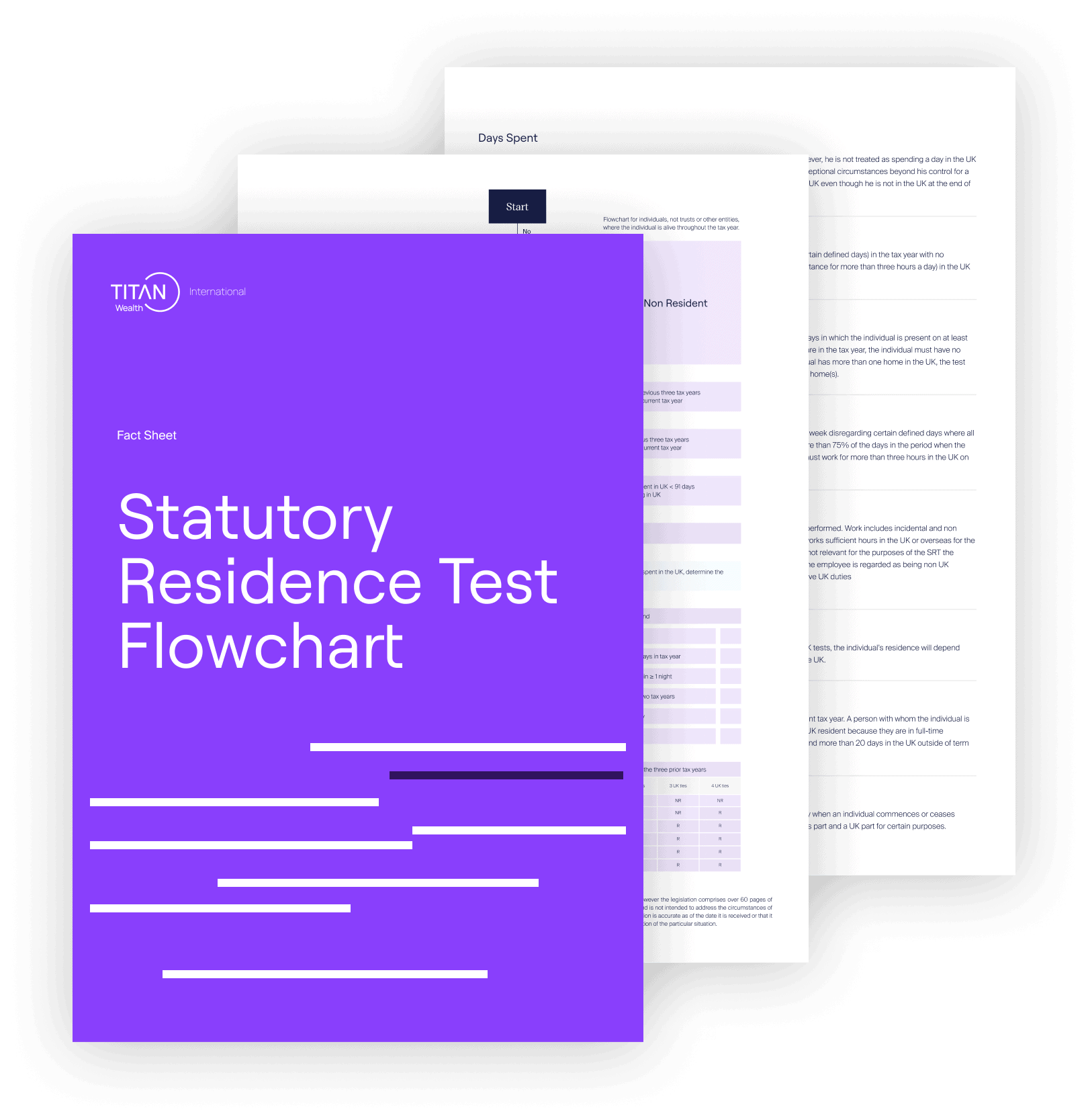
Flowchart
UK Statutory Residence Test Flowchart
Our Statutory Residence Test Flowchart is designed to help you start unravelling the complexities, providing a visual outline of the key steps.
Returned to the UK from the Gulf, or considering a temporary move back?
What Counts as Exceptional Circumstances Under the UK Statutory Residence Test (SRT)?
Under the UK Statutory Residence Test, a day is generally counted as a UK day if an individual is present in the UK at midnight, subject to limited exceptions such as transit.
Where exceptional circumstances apply, up to 60 days may be disregarded, but only where circumstances beyond the individual’s control prevent them from leaving the UK and they leave as soon as those circumstances allow. Those days are relevant only for particular parts of the SRT day-counting framework, not for every residence factor.
The exceptional circumstances rule is likely to be relevant only where:
- The circumstances are beyond the individual’s control.
- Those circumstances genuinely prevent them from leaving the UK.
- The individual intends to leave the UK.
- They leave as soon as circumstances reasonably allow.
That sounds simple, but the rule is not a broad fairness provision. It is not enough that leaving the UK was inconvenient, expensive or unattractive.
The issue is whether the individual was genuinely prevented from leaving the UK, and whether the facts support that conclusion.
HMRC’s approach remains narrow. Official travel advice is not conclusive in every case, but it can be strong evidence.
In particular, HMRC indicates that exceptional circumstances will generally not apply to events that bring someone back to the UK, but may do so in cases such as civil unrest or natural disaster where official advice is to avoid all travel to the region, subject to the 60-day limit and the individual facts.
When International Disruption Can Create Unexpected UK Tax Residence Risk
Global instability does not affect all expats in the same way. Some may be evacuated from a region entirely. Others may delay their return because routes have become unreliable, security conditions have deteriorated or onward travel has become impractical. Some may still be able to travel in theory, but not by any route that is realistic or safe in practice.
Each of those situations may feel exceptional. They are not always exceptional in the legal sense. That is why residence analysis should never be reduced to whether a crisis existed. The more important question is how that crisis affected the individual’s ability to leave the UK in practice.
For expats already back in the UK, the issue can arise quickly. Even where the original intention was to remain only briefly, a stay can extend because schools, housing, work arrangements or travel conditions take longer to resolve than expected.
That is often the point at which a practical short-term decision starts to become a tax residence issue.
How Regional Tensions Involving Iran May Affect UK Expats in the UAE and Gulf States
For many UK expats, the practical impact of the current Iran-related conflict is being felt less inside Iran itself and more across the UAE and wider Gulf region, where regional escalation has created security concerns and travel disruption.
For UK expats based in the UAE and wider Gulf, disruption may arise through:
- cancelled or delayed flights
- reduced airline capacity
- regional airspace restrictions
- security concerns affecting onward travel
- employer-led changes to travel or work arrangements
That matters because the tax issue is often not about being in a conflict zone itself. It is about what happens when someone based in Dubai, Abu Dhabi or elsewhere in the Gulf returns to the UK temporarily, delays onward travel, or cannot leave the UK as planned because flights, routes or regional airspace are disrupted.
For expats in the Gulf, this can create an important SRT issue. If an individual would normally have returned to their Gulf base but instead remains in the UK because disruption genuinely prevents travel, the exceptional-circumstances rules may become relevant.
Even so, the analysis should also consider split-year treatment where available and, where the individual may be resident in two jurisdictions, the relevant double tax treaty position.
But the position is still highly fact-specific. Travel warnings, instability or commercial inconvenience do not automatically mean UK days can be disregarded.
What matters is whether the individual was genuinely prevented from leaving the UK, and whether they left as soon as circumstances reasonably allowed.
This is especially relevant in the UAE and wider Gulf because disruption may sit in a grey area between possible in theory and realistic in practice.
That does not automatically create an exceptional circumstances claim, but it does strengthen the case for careful day-count monitoring, evidence gathering and early cross-border planning review.
Even when an individual becomes a UK resident for a tax year, the analysis does not always end there.
Split-year treatment may need to be considered if the statutory conditions for one of the split-year cases are met, and where more than one country may regard the individual as resident, the relevant double tax treaty may also need to be reviewed separately.
Domestic residence and treaty residence are related, but they are not always the same thing.
Returning to the UK Temporarily: What Expats Should Consider
For many expats in the UAE and wider Gulf, a temporary return to the UK may feel like the most sensible option while tensions remain elevated.
It may offer family stability, access to support networks or simply more certainty in the short term.
However, a temporary return is not neutral from a tax perspective. Additional UK days can affect the SRT, and the issue is not whether returning is sensible or justified, but whether the length and facts of the stay begin to change the residence outcome.
Before returning to the UK temporarily, or before extending a stay that was meant to be short, expats should consider:
- How many UK days they have already spent in the tax year.
- Whether a short stay could realistically become a longer one.
- Whether they may trigger one or more defined UK ties under the SRT, including family, accommodation and work ties, as these can materially reduce the number of UK days available before residence risk arises.
- Whether they may need evidence why they returned or remained in the UK.
- How a change in residence position could affect wider financial planning.
This does not mean expats should avoid returning to the UK where it is the right decision for their family. It means the decision should be made with a clear understanding of how quickly temporary arrangements can create longer-term tax consequences.
Why Exceptional Circumstances Are Not a Simple Exemption
One of the biggest misunderstandings is to treat exceptional circumstances as a blanket exclusion. It is not.
Exceptional circumstances are not a planning strategy and should not be relied on to create additional UK days by choice
The rule is intended to deal with genuine situations where an individual is prevented from leaving the UK by circumstances beyond their control, not where they simply decide to remain in the UK for convenience, preference or ordinary disruption.
Circumstances that will not usually qualify include:
- Delayed or missed flights.
- Visa delays.
- Ordinary life events.
- Voluntary travel to the UK for medical treatment.
- Disruption that is inconvenient rather than genuinely preventative.
This helps create a clearer distinction between genuine exceptional circumstances and situations that merely make travel more difficult.
It is also important to remember that exceptional-circumstances days are relevant only for specific SRT day-counting rules. They do not automatically eliminate all UK ties or all other residence consequences, so the analysis must be carried out across the whole test.
That is why residence analysis should always be reviewed in the round rather than relying on the exceptional circumstances rule in isolation.
The Wider Financial Planning Impact of a Change in UK Tax Residence
For expats, UK tax residence rarely affects just one area of life. A change in residence can alter how income and capital gains are taxed. It can also create new UK filing and reporting obligations. In some cases, it may also lead to overlap with the tax rules of another country, which means treaty analysis may be needed.
A change in residence can also affect how certain investment wrappers are taxed. This can be particularly relevant for life assurance-based investment bonds, including offshore policies. A product that was tax-efficient while you were a non-UK resident may not be taxed in the same way after a return to the UK. Because these rules are highly fact-specific, assumptions can be costly.
From 6 April 2025, UK residents are generally taxed on the arising basis on their worldwide income and gains. Some individuals returning to the UK after at least 10 consecutive tax years of non-UK residence may qualify for the foreign income and gains regime for their first four years of UK residence. This means that the timing of a return can affect both immediate tax exposure and access to valuable reliefs.
The consequences of becoming a UK tax resident, even for a relatively short period, can be significant. In practice, decisions taken before UK residence is triggered can materially affect the outcome, while options may become more limited once key UK day thresholds are approached or exceeded.
That is why early advice matters. Reliance on exceptional circumstances is not a robust tax planning strategy, and expats with investment structures or wrappers in place should review them before an unexpected return creates tax consequences that may be difficult to unwind.
This can be particularly important where a portfolio bond or similar wrapper may form part of longer-term planning. If UK residence arises unexpectedly, restructuring assets later may create adverse tax consequences, including crystallising gains that might otherwise have been managed more efficiently.
In practice, what begins as a day-counting issue can quickly become a wider financial planning issue. The risk is not only of becoming a UK resident unexpectedly. It is failing to recognise how that change can affect investment strategy, retirement planning and longer-term cross-border wealth structuring.
For expats returning to the UK temporarily, the broader planning question is often just as important as the technical residence test itself. A short-term move can affect not only tax status, but also the assumptions behind wider financial decisions.
What begins as a day-counting issue can quickly become a wider financial planning issue.”

Rebecca Ellis
Head of Advice
What Expats Should Do If Their Time in the UK Extends Unexpectedly
The best response is early review, not retrospective repair. If an expat spends longer in the UK than planned, they should:
- Monitor their UK day count carefully.
- Keep a clear record of why they are in the UK.
- Retain evidence of cancelled or disrupted travel.
- Keep copies of employer instructions and travel advisories.
- Review whether their wider cross-border planning still works.
- Review any accommodation, family and work ties to the UK.
- Consider whether a short-term return may now become a longer stay.
- Take advice before assumptions become tax issues.
Clear records matter. UK residence is self-assessed, and evidence can be critical if HMRC later challenges the position.
The key question is rarely just whether certain days can be ignored. The more important issue is what an unexpected period in the UK means for the wider financial position of the individual or family.
Once UK day thresholds start to tighten, the scope for corrective action can narrow quickly. That is why early review matters. The earlier residence risk is identified, the easier it is to assess whether wider tax planning, investment structures, reporting positions and cross-border assumptions still remain appropriate.
How Titan Wealth International Helps Expats Navigate UK Tax Residence
At Titan Wealth International we specialise in expat financial advice and wealth management, with a cross-border focus and support for clients whose planning involves UK and international tax considerations.
For expats facing uncertainty around UK presence, that matters because residence issues do not exist in a vacuum. They can affect tax planning, investment decisions, retirement strategy and the wider management of international wealth.
Titan Wealth International can help expats to:
- Understand the broader implications of a change in residence position.
- Identify where financial planning assumptions may need to change.
- Coordinate cross-border wealth planning decisions.
- Review how tax, investment and retirement planning interact.
- Bring structure to periods of uncertainty and disruption.
Our role is to help expats understand the broader implications of a change in circumstances, identify where wealth planning assumptions may need to shift and bring structure to decisions.
In a world where mobility can be disrupted without warning, resilient cross-border planning matters more than ever.
Complimentary UK Tax Residence Consultation
If you have returned to the UK because of conflict in the Gulf, or are considering doing so temporarily, it is important to understand how additional UK days could affect your residence position and wider financial planning.
In a complimentary introductory consultation with Titan Wealth International, you will:
- Review how your current or planned time in the UK may affect your position under the Statutory Residence Test.
- Understand how a temporary return could influence wider cross-border tax and financial planning considerations.
- See how Titan Wealth International can help you bring structure and clarity to decisions during a period of uncertainty.

Key Takeaway
Exceptional circumstances under the SRT can provide limited protection, but they are not a catch-all solution.
For expats, the real priority is not simply whether a small number of UK days can be disregarded, but whether an unexpected change in presence could alter the wider tax and financial planning picture.
The most effective approach is to act early, keep clear evidence and view tax residence as part of a broader cross-border wealth strategy.
If your time in the UK has changed unexpectedly, Titan Wealth International can help you assess the wider financial planning implications, bring structure to cross-border decisions and ensure your wealth strategy remains aligned with your long-term objectives.
This article is provided for general information only and reflects our understanding at the date of publication. It does not constitute personalised financial, investment, tax or legal advice and does not take account of your individual circumstances. Tax, legal and regulatory treatment varies between jurisdictions, and you should seek professional advice appropriate to the countries in which you may have liabilities. Titan Wealth International accepts no liability for any direct or indirect loss arising from reliance on this information, or for any errors or omissions.