







The UK Statutory Residence Test (SRT) determines whether you are a UK resident for tax purposes in a particular tax year. For expats, international professionals and those moving to or from the UK, your residence status can have a significant effect on how your income and gains are taxed.
This guide explains how the UK residency tests work, including the automatic overseas tests, automatic UK tests and sufficient ties test. It also covers day counting, split-year treatment and other rules that can affect your tax position when leaving or returning to the UK.
What You Will Learn
- What the UK Statutory Residence Test is, and how it impacts your tax status?
- The criteria for the automatic overseas, UK tests, and sufficient ties test.
- How to strategise your UK and overseas stays to align with tax residency goals.
- Understand split year treatment for mid-year residency changes.
- How to prepare effectively for the UK Statutory Residence Test.
What Is the Statutory Residence Test?
The Statutory Residence Test (SRT) determines whether an individual is a UK resident for tax purposes for a particular tax year. Your residence status is particularly relevant to how the UK taxes your income and capital gains
The SRT looks at factors including how many days you spend in the UK, where you have a home, where you work and your ties to the UK. There is no single day limit that determines residence in every case.
Your residence status is assessed separately for each tax year, so it can change from one year to the next. If you are a UK resident, you will generally be subject to UK tax on your worldwide income and gains, although exemptions and reliefs may apply. If you are non-UK resident, you may still have UK tax liabilities on certain UK income and gains.
Inheritance Tax is subject to separate rules. From 6 April 2025, whether overseas assets fall within the scope of UK Inheritance Tax can depend on your long-term UK residence status, which is based on your UK residence history.
How Does the Statutory Residence Test UK Work?
The Statutory Residence Test UK works as a three-step test to accurately determine your UK tax residency status and understand your tax obligations. Each step has specific criteria. The three steps are:
- Automatic overseas test.
- Automatic UK test.
- Sufficient ties test.
Each step needs to be reviewed in turn and if a conclusion is not reached you move on to the next. As soon as your situation meets the criteria at any step, your residency status is decided. Therefore, If you are determined to be a non-resident through the automatic overseas tests, there is no need to consider the subsequent tests.
When Am I Not Classified as a UK Resident for Tax Purposes
You will not be considered a UK resident for tax purposes if:
- You meet the requirements of the automatic overseas test;
- Or you fail to pass the automatic UK test and keep within your allowed UK visiting limit according to the sufficient ties test.
Below, we will look at each residency test’s requirements in more detail.
Reviewing Your UK Tax Residency Position?
Automatic Overseas Tests
The automatic overseas tests are designed to establish if you are considered a non-resident in the UK for tax purposes. The HMRC automatic overseas tests are the first step in the Statutory Residence Test process. They determine if you are not a UK resident based on specific factors like your days spent in the UK and work habits. There are five automatic overseas tests. If you meet the criteria for any of these tests, you will be regarded as a non-UK resident for the relevant tax year.
First Automatic Overseas Test
The first automatic overseas test applies if you spent fewer than 16 days in the UK during the current tax year and were a UK resident in one or more of the three preceding tax years.
Second Automatic Overseas Test
The second automatic overseas test applies if you were not a UK resident in any of the three preceding tax years and spent fewer than 46 days in the UK in the current tax year.
Third Automatic Overseas Test
The third automatic overseas test can apply if you work full-time overseas over the tax year, have no significant break from overseas work, spend fewer than 91 days in the UK and work for more than three hours in the UK on no more than 30 days.
What Is ‘Sufficient Hours Abroad’ Defined As?
The sufficient-hours test requires an average of at least 35 hours of overseas work a week. The SRT uses a specific calculation to work out that average, with adjustments for certain days and periods, rather than simply dividing total overseas hours by the number of weeks worked.
What Is a ‘Significant Break’ Defined As?
A significant break occurs where at least 31 days pass without a day on which you work for more than three hours overseas, or would have worked for more than three hours overseas but for annual leave, sick leave or parenting leave.
To ensure compliance with the third automatic overseas test, you should keep detailed records of your work hours, breaks from work, and days spent in the UK is essential to help your claim of non-residency to HMRC.
The remaining two tests cover the position where an individual dies during the year. As you navigate the automatic overseas tests, it’s crucial to consider how double taxation agreements between the UK and other countries might affect you.

UK Repatriation Service For Expats
Return to the UK with confidence. Our repatriation tax service helps you manage complex UK tax rules, protect your assets, and plan a smooth, tax-efficient transition with Titan Wealth International.
Automatic UK Tests
For a living individual, there are three automatic UK tests. A fourth automatic UK test applies only where an individual dies during the tax year.
First Automatic UK Test
The first automatic UK test considers your physical presence in the UK. You are resident in the UK for the tax year if: You spend 183 days or more in the UK during the tax year.
Second Automatic UK Test
You meet the second automatic UK test if:
- You have a UK home during at least one period of 91 consecutive days;
- At least 30 days of that 91-day period fall within the tax year;
- You are present in that UK home on at least 30 days during the tax year; and
- During the relevant period, you either have no overseas home or, if you have an overseas home, you are present in it for fewer than 30 days during the tax year.
Third Automatic UK Test
The third automatic UK test assesses your work activity in the UK. You meet this test if:
- You ‘work full-time in the UK’ for any period of 365 days, with no ‘significant break’ from UK work, and;
- More than 75% of your total workdays in the 365-day period are spent working in the UK and;
- At least one day that falls within both the 365-day period and the tax year must be a day on which you work for more than three hours in the UK.
If you meet any of these automatic UK tests, you are classified as a UK resident for that tax year. If, however, your residency status remains unclear, the sufficient ties test may be used to clarify your residency status further based on additional connections to the UK.
UK Sufficient Ties Tests
If your residency status cannot be conclusively determined through the automatic overseas and automatic UK tests, the UK sufficient ties test is next. This part of the Statutory Residence Test evaluates your connections – or ‘ties’ -to the UK to decide your residence status. The sufficient ties test is relevant as the number of ties needed to be considered a UK resident varies depending on whether you are arriving in or leaving the UK.
- You are determined as an ‘arriver’ if you have been a non-resident in all of the three tax years preceding the tax year under consideration.
- You are determined as a ‘leaver’ if you have been a resident in one or more of the three tax years preceding the tax year under consideration.
The number of connecting ties with the UK that apply for the year are reviewed using the following five UK sufficient ties tests:
- Family tie.
- Accommodation tie.
- Work tie.
- 90-day tie.
- Country tie.
Family Tie
A family tie can arise through a UK-resident spouse, civil partner or partner with whom you are living as spouses or civil partners. A child under 18 can also create a family tie, although specific exceptions apply, including rules for some children in full-time education.
Accommodation Tie
The accommodation tie assesses your connection to the UK through living arrangements. You establish an accommodation tie if:
- A residential property in the UK is available for your use as a place of residence.
- The property is available for your use for a continuous period of at least 91 days during the tax year.
- You spend at least one night in the tax year at that property.
An important consideration in evaluating this tie is the relationship with the property owner and the duration of your stay: If the accommodation is owned by close family members, such as parents, grandparents, siblings, or adult children and grandchildren, staying at the property for up to 15 nights in the tax year does not, by itself, establish an accommodation tie.
Work Tie
The work tie assesses the level of work activity conducted in the UK during the tax year. This tie is triggered if:
- You work in the UK for at least 40 days in the tax year.
- A ‘day of work’ is any day you perform more than 3 hours of work in the UK. This includes any day where you are not in the UK at the end of that day.
90-day Tie
The 90-day tie statutory residence test examines the number of days spent in the UK in previous tax years. The 90-day tie is triggered if:
- You spend more than 90 days in the UK in either or both of the two tax years immediately preceding the current tax year.
Country Tie
The country tie applies only if you have been classified as a UK resident for at least one of the preceding three tax years. It assesses where you predominantly spend your time during the tax year. The criteria for establishing a country tie are clear:
- You have a country tie if the UK is where you spend the most days throughout the tax year.
Counting UK Days for the Statutory Residence Test
When determining the number of days spent in the UK for the Statutory Residence Test:
- A day is generally counted as a ‘UK day’ if you are present in the UK at midnight. However, there are exceptions for individuals transiting through the UK without a significant stopover.
- Days of departure are not typically included in the count of UK days for the SRT, except for the application of the deeming rule outlined below.
The Deeming Rule
The deeming rule can affect how certain days are counted for the Statutory Residence Test. It can apply if:
- You were a UK resident in at least one of the previous three tax years.
- You have at least three UK ties for the current tax year.
- You have more than 30 qualifying days in the UK during the tax year.
A qualifying day is generally a day when you are present in the UK but are not in the UK at the end of the day. If the deeming rule applies, qualifying days after the first 30 are treated as UK days for relevant parts of the Statutory Residence Test.
Will I Be Classified As a UK Resident Under The Sufficient Ties Test?
The tables below show the relationship between the number of days spent in the UK and the required number of ties for both arrivers and leavers to be considered UK residents under the Sufficient Ties Test.
| For Individuals Non-Resident Throughout the Three Prior Tax Years (Arrivers) | ||||
|---|---|---|---|---|
| Number of days in the UK in the tax year | 1 or No UK ties | 2 UK ties | 3 UK ties | 4+ UK ties |
| Fewer than 16 days | Non-Resident | Non-Resident | Non-Resident | Non-Resident |
| 16 to 45 days | Non-Resident | Non-Resident | Non-Resident | Non-Resident |
| 46 to 90 days | Non-Resident | Non-Resident | Non-Resident | Resident |
| 91 to 120 days | Non-Resident | Non-Resident | Resident | Resident |
| 121 to 182 days | Non-Resident | Resident | Resident | Resident |
| 183 days plus | Resident | Resident | Resident | Resident |
| For Individuals Resident in the UK in Any of the Three Prior Tax Years (Leavers) | ||||
|---|---|---|---|---|
| Number of days in the UK in the tax year | 1 or No UK ties | 2 UK ties | 3 UK ties | 4+ UK ties |
| Fewer than 16 days | Non-Resident | Non-Resident | Non-Resident | Non-Resident |
| 16 to 45 days | Non-Resident | Non-Resident | Non-Resident | Resident |
| 46 to 90 days | Non-Resident | Non-Resident | Resident | Resident |
| 91 to 120 days | Non-Resident | Resident | Resident | Resident |
| 121 to 182 days | Resident | Resident | Resident | Resident |
| 183 days plus | Resident | Resident | Resident | Resident |
Statutory Residence Test Exceptional Circumstances
The Statutory Residence Test includes provisions for ‘exceptional circumstances’ that can affect the days spent in the UK. These provisions are designed to offer flexibility in situations where your presence in the UK is beyond your control.
Understanding Exceptional Circumstances
Exceptional circumstances are specific events or situations that mean you have to remain in the UK beyond your planned time, potentially affecting your residency status. The Statutory Residence Test allows up to 60 days to be disregarded in certain situations when counting your days in the UK, provided these days result directly from exceptional circumstances. Exceptional circumstances may include, but are not limited to, the following scenarios:
- Sudden or life-threatening Illness or Injury: If you or a close family member becomes seriously ill or suffers an injury while in the UK, requiring your presence.
- Natural disasters: Events such as earthquakes, floods, or volcanic eruptions that prevent you from leaving the UK as planned.
- Civil unrest or war: Situations where political instability, civil unrest, or war conditions in another country prevent you from returning to that country from the UK.
- Travel disruptions: Severe and unexpected disruptions to travel, including pandemics, that stop you from leaving the UK. This might include cancelled flights due to volcanic ash clouds or border closures.
Understanding Temporary Non-Residence and Its Tax Implications
Temporary non-residence rules can apply when someone leaves the UK, becomes non-resident and then resumes UK residence after a relatively short period abroad. The rules can bring certain income and gains arising during the period of non-residence into charge to UK tax when the individual returns.
The temporary non-residence rules can apply where you had sole UK residence in at least four of the seven tax years immediately preceding your year of departure and your period without sole UK residence lasts five years or less.
If the rules apply, certain income and gains arising during your period abroad may become taxable when you resume UK residence. These can include certain capital gains, distributions from closely controlled companies, certain pension payments and lump sums, chargeable event gains and other specified income or gains. Separate conditions apply to each category.
If you are considering returning to the UK, professional tax advice can help you establish whether the temporary non-residence rules apply and whether transactions made while you were abroad could become taxable on your return.
The Temporary Non-Residence ‘Five-Year Trap’
A common misunderstanding about the temporary non-residence rules is how the five-year period is calculated. The threshold is based on your period of non-residence, rather than requiring five complete UK tax years of non-residence.
Where split-year treatment applies, the period of non-residence can begin or end partway through a tax year. Broadly, the temporary non-residence rules can apply where your period without sole UK residence lasts five years or less, provided the other conditions are met. This means the exact dates on which your period of non-residence begins and ends can be important.
Another common misconception is when the tax liability arises. The temporary non-residence charge does not usually arise while you are abroad. Instead, if you return to the UK within the relevant period, certain income and gains arising during your temporary period of non-residence may become taxable in the year you resume UK residence.
This can create an unexpected outcome: a transaction may have taken place several years earlier, no UK tax may have been paid at the time, and you may have assumed the matter was closed. The delay between the transaction and the potential UK tax charge is what makes the rules easy to overlook.
Certain groups tend to be particularly exposed to this risk:
- Business owners and entrepreneurs who dispose of shares or extract value from closely held companies during their time abroad.
- Individuals on short-term overseas postings who do not anticipate returning within five years, but ultimately do.
- Senior executives who move abroad for a new position without considering how a future return to the UK could affect asset disposal decisions.
If you are considering returning to the UK at any point, decisions regarding certain transactions, including asset disposals and distributions from closely controlled companies, during your period abroad should be made well in advance, as the timing of transactions can have significant tax consequences.
Overseas Workday Relief
Overseas Workday Relief (OWR) reduces UK tax on the part of your employment income that relates to duties performed outside the UK when you work both in the UK and abroad.
The relief was reformed from 6 April 2025, and it no longer depends on your domicile or on claiming the remittance basis (both of which were abolished). Instead, you qualify for OWR if you are eligible for the new four-year Foreign Income and Gains (FIG) regime, i.e., if you were a non-UK resident for the previous ten tax years.
Under the reformed rules, the relief is:
- Available for your first four tax years of UK residence (up from three).
- Applicable whether or not the overseas earnings are brought into the UK.
- Capped each year at the lower of £300,000 or 30% of your qualifying employment income.
Making an OWR election means giving up your income tax personal allowance and capital gains tax annual exemption for that year, so it is only worthwhile where a meaningful share of your duties is performed overseas. Careful workday tracking and apportionment remain essential.
Split Year Treatment and the Statutory Residence Test
The split year treatment within the Statutory Residence Test addresses the complexities of changing residency status during a tax year, providing a mechanism for individuals who either leave or return to the UK partway through the tax year.
Where split-year treatment applies, you remain a UK resident for the tax year, but the year is divided into a UK part and an overseas part. Different tax rules then apply to the two parts.
Understanding Split Year Treatment
Split year treatment is applicable in eight specific scenarios or ‘cases’, each defined by its criteria to accommodate different circumstances of arriving in or leaving the UK – refer to HMRC’s RDRM12000 for further details. This ensures that individuals’ tax obligations accurately reflect their residency status and connections to the UK during the year.
Cases for Leaving the UK
For individuals leaving the UK, split year treatment can apply under three primary scenarios:
- Starting full-time work overseas: You must have been a UK resident in the preceding year, undertaken full-time work abroad, and limited your visits back to the UK within pro-rata restrictions.
- Accompanying a partner working full-time overseas: Similar conditions apply, emphasising the need for a clear break from the UK.
- Ceasing to have a UK home: Indicating a move to live abroad permanently or for an extended period.
Cases for Arriving in the UK
For those arriving in the UK, scenarios include:
- Establishing the only home in the UK: Signifying the UK as your primary place of residence.
- Starting full-time work in the UK: Indicating a significant economic connection to the UK.
- Ceasing full-time work overseas: Transitioning from work abroad to living in the UK, possibly with or without immediate employment.
- Accompanying a partner returning to the UK: After their period of full-time work overseas.
- Starting to have a home in the UK: Establishing a residence in the UK, whether rented or owned.
What You Should Consider for Split Year Treatment?
Strict criteria and previous residency: Eligibility for split year treatment, especially when leaving the UK, requires meeting stringent criteria, including evidence of a significant lifestyle change and adherence to the rules about the number of days spent in the UK after departure.
Pro-rata limitations on UK visits: After leaving the UK, maintaining the non-resident part of the year under split year treatment necessitates careful management of time spent back in the UK to ensure it does not exceed specified limits.
Deeming rule for counting days: The deeming rule may apply, particularly affecting how days of departure from the UK are counted, restricting the exclusion of such days to a maximum of 30 if you have been a UK resident in one of the previous three years and have at least three UK ties.
How Split Year Treatment Impacts Your Tax Obligations?
Split year treatment significantly impacts how you are taxed on:
- Income tax on worldwide earnings and gains.
- Capital gains tax on the disposal of assets.
When applied, it means that for part of the year, your foreign income and gains may not be subject to UK tax, aligning your tax obligations more closely with their actual residency status and lifestyle during the tax year. Navigating the challenges of split year treatment demands a thorough understanding of the criteria for each specific case, making it challenging. Seeking professional cross-border financial advice is highly recommended to ensure precise application and adherence to UK tax laws. If you’re considering returning to the UK after a period abroad, understanding the implications of repatriation on your tax status is crucial. Our UK Repatriation service provides tailored advice and support to ensure a smooth transition back to UK residency, addressing the nuances of the split year treatment and how it applies to your circumstances.

Guide
Navigating UK residency rules?
Your tax position can shift dramatically depending on your residency status. Our International Portfolio Bonds Guide shows how expats and returning Brits can structure their investments tax-efficiently
Statutory Residence Test Flowchart
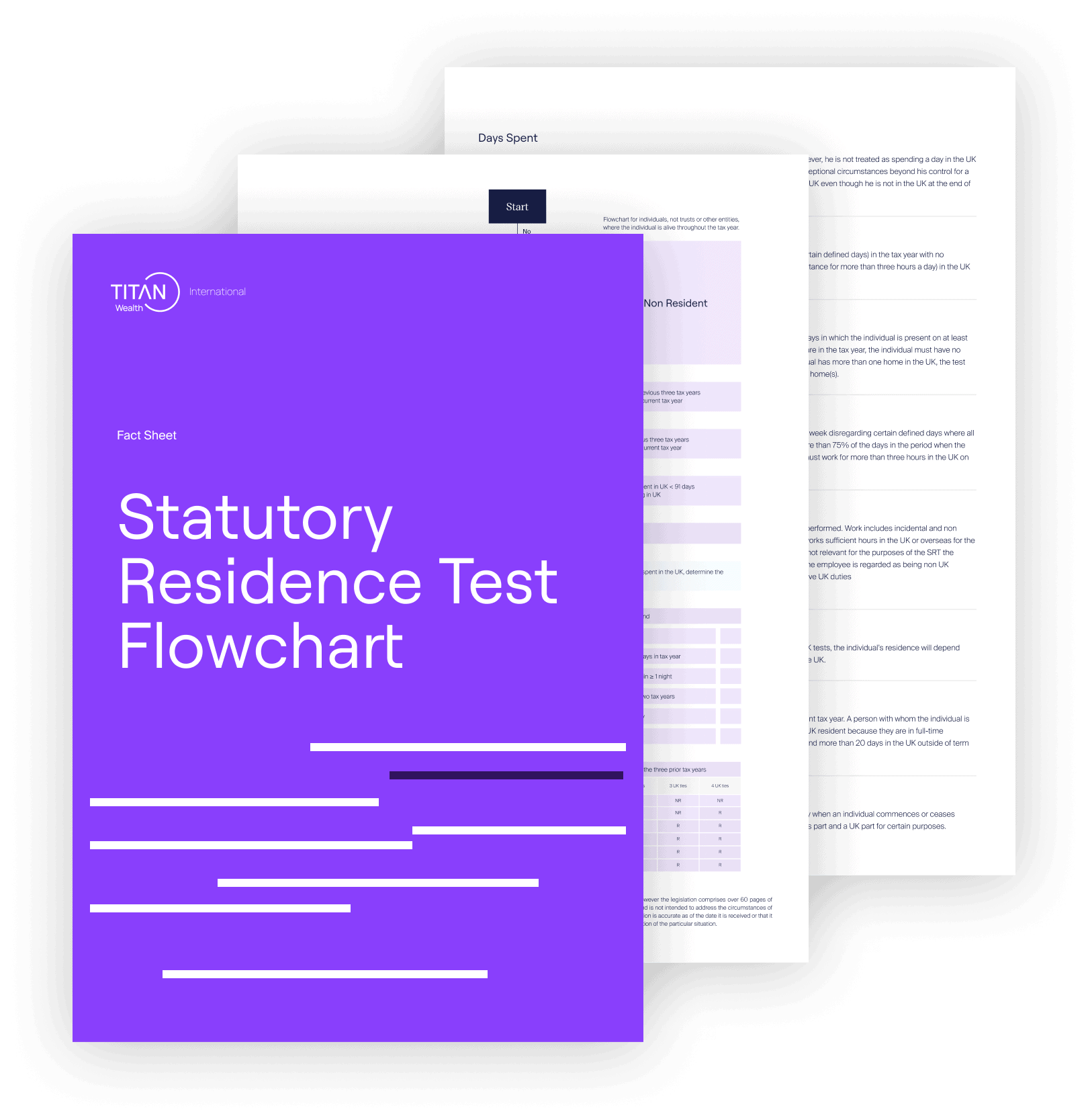
The Statutory Residence Test Flowchart is a visual tool designed to simplify the process of determining your tax residency status in the UK.
It guides you through the various tests and conditions outlined in the SRT, including the automatic overseas tests, automatic UK tests, and the sufficient ties test. It visually breaks down the criteria and decision points, making it easier to follow.
By following the flowchart, you can navigate the complexities of the Statutory Residence Test more clearly.
The flowchart is designed to provide precise, step-by-step assistance, ensuring you consider all relevant factors and tests for the Statutory Residence Test.
However, considering the complexities involved with the Statutory Residence Test, we advise consulting with a professional specialising in cross-border financial advice to ensure accurate application and compliance with UK tax laws.
Flowchart
UK Statutory Residence Test Flowchart
Our Statutory Residence Test Flowchart is designed to help you start unravelling the complexities, providing a visual outline of the key steps.
The Impact of SRT on Expats
The Statutory Residence Test has significant implications for British expats living and working outside the UK or those considering moving abroad. Understanding the UK Statutory Residence Test is crucial for expats to accurately determine their UK tax residency status, which directly affects their tax obligations to the UK government. Here’s how the SRT impacts expats:
- Determining tax residency status: This determination is vital as it dictates whether you are liable for UK taxes on your worldwide income and gains or only on your UK-sourced income.
- Worldwide income and gains: UK residents are generally subject to UK tax on worldwide income and gains. However, qualifying new residents may be able to claim relief on eligible foreign income and gains under the four-year Foreign Income and Gains (FIG) regime. Non-residents are generally subject to UK tax on certain UK-source income and may also be liable to UK tax on certain gains, including gains relating to UK land and property.
- Split year treatment: Expats moving to or from the UK part way through a tax year may benefit from split year treatment, allowing you to be taxed as a UK resident only for the part of the year they were in the UK. This is particularly relevant for those who permanently relocate in the middle of a tax year, ensuring you are not unfairly taxed after you have moved.
- Impact on investments and retirement planning: As an expat, your investment and retirement planning can be affected by your UK tax residency status. The tax treatment of pensions, savings, and investments may vary substantially depending on whether you are considered a UK resident or non-resident under the Statutory Residence Test.
The SRT’s impact on expats is profound, influencing their tax obligations, financial planning, and lifestyle decisions. By accurately determining your residency status, you can ensure you meet your tax obligations while potentially minimising unnecessary liabilities. Given the complexities and nuances of the Statutory Residence Test, seeking professional advice is highly recommended to navigate this critical aspect of expat life effectively.
Schedule Your 15-Minute Statutory Residence Consultation
Gain clarity on your residency and tax status with a 15-minute consultation. In this call, you’ll:
- Get an instant assessment of your statutory residence position.
- Explore potential tax strategies tailored to your situation.
- Learn how others in similar circumstances have maximised their tax benefits.

How To Prepare for the Statutory Residence Test
Preparing for the Statutory Residence Test is essential for you to accurately determine your tax residency status in the UK. Here key steps and considerations to effectively prepare for the SRT:
Understand the SRT Framework
Begin by understanding the three main components of the SRT- the automatic overseas tests, the automatic UK tests, and the sufficient ties test. You can download the Statutory Residence Test here.
Keep Detailed Records
- Track days spent in the UK: Maintain a detailed record of the days you spend in the UK, noting the dates of arrival and departure. Remember, the SRT often considers a day in the UK as any day you are in the country at midnight.
- Document work patterns: For both the automatic overseas and UK tests, your work pattern is crucial. Keep records of where and when you work, especially if you’re claiming full-time work abroad.
- Accommodation records: Document your living arrangements, including addresses, rental agreements, or ownership details, to support or refute an accommodation tie.
- Family and social ties: Note any significant family ties or social connections to the UK, as these can influence your residency status under the sufficient ties test.
Review Previous Years
Analyse your residency status and ties to the UK in previous tax years, as these can impact your current year’s status, especially for determining if you qualify for split year treatment.
Plan Your Travel and Work
- Strategic planning: If nearing the threshold that might change your residency status, carefully plan any work or personal travel to the UK or abroad. This planning can help you maintain your desired residency status.
- Understand the work tie: If working in the UK, be mindful of the 40-day threshold that could establish a work tie under the sufficient ties test.
Consult With Tax Professionals
Given the complexity of the SRT and its significant impact on your tax obligations, seek advice from tax professionals, especially those experienced in cross-border taxation. Preparing for the Statutory Residence Test requires a comprehensive approach, including thorough documentation, an understanding of the tests involved, and strategic planning of your time in and out of the UK. By taking these steps, you can accurately determine your residency status and manage your tax obligations effectively. Consulting with professionals is highly recommended to navigate the complexities of the UK Statutory Residence Test and ensure compliance with UK tax regulations.
Statutory Residence Test Guidance
At Titan Wealth International, we understand that navigating the complexities of the UK Statutory Residence Test can be daunting and fraught with the potential for costly mistakes that could seriously impact your plans and the net income you were expecting. Mistakes in determining your tax residency status can lead to significant financial implications, underscoring the importance of getting it right the first time. That’s why we offer comprehensive Statutory Residence Test guidance tailored to your unique circumstances, ensuring you can manage your tax obligations effectively and confidently. Our expert team specialises in UK expat tax advice and is dedicated to providing personalised advice, whether you’re moving to the UK, planning to leave, or living abroad. We offer:
- Tailored advice: Personalised consultations to understand your situation and provide clear, actionable advice on your tax residency status and obligations.
- UK Repatriation Service: Specialised support for individuals returning to the UK, including guidance on the split-year treatment and how it affects your tax status.
- Record-keeping assistance: Help maintain detailed records essential for the SRT, including days spent in the UK, work patterns, accommodation, and family ties.
- Strategic planning: Expert advice on planning your travel and work to align with your tax residency goals, helping you avoid unwanted changes in your tax status.
- Professional navigation: Assistance in understanding and applying the complex criteria of the Statutory Residence Test to your advantage.
- Ongoing support: Continuous advice and support as tax laws evolve and circumstances change.
Take Control of Your Tax Residency
Don’t let the complexities of the Statutory Residence Test overwhelm you. With Titan Wealth International, know that you have a partner dedicated to helping you navigate your tax residency easily. Whether you’re concerned about income tax, capital gains, or inheritance tax implications, our team ensures your tax planning is efficient, compliant, and tailored to your needs.
Frequently Asked Questions
There is no single day limit that applies in every situation. The Statutory Residence Test considers the number of days you spend in the UK alongside factors such as your previous UK residence, work, accommodation and family ties.
For example, if you were a UK resident in one or more of the previous three tax years, spending fewer than 16 days in the UK can satisfy the first automatic overseas test. If you were not a UK resident in any of the previous three tax years, spending fewer than 46 days can satisfy the second automatic overseas test.
Exceeding these limits does not automatically make you a UK resident. The other automatic tests and, where necessary, the sufficient ties test must also be considered.
Potentially. The temporary non-residence rules can bring certain income and gains arising during a period of non-residence into charge when you resume UK residence.
Broadly, the rules can apply where you had sole UK residence in at least four of the seven tax years immediately preceding your year of departure and your period without sole UK residence lasts five years or less. Different conditions apply to different types of income and gains, so returning within five years does not mean that everything earned or realised while abroad automatically becomes taxable in the UK.
No. The Statutory Residence Test determines residence using factors such as days spent in the UK, work, homes and UK ties rather than domicile.
From 6 April 2025, the remittance basis was replaced by the residence-based Foreign Income and Gains (FIG) regime. These reforms did not replace the Statutory Residence Test, which continues to determine whether an individual is a UK resident for a tax year.
If the automatic tests do not determine your residence status, the sufficient ties test considers the number of days you spend in the UK alongside your connections to the UK.
The relevant ties can include family, accommodation, work and whether you spent more than 90 days in the UK in either of the previous two tax years. A country tie can also apply if you were a UK resident in at least one of the previous three tax years.
The number of ties needed for UK residence depends on how many days you spend in the UK and your residence history. Generally, the more days you spend in the UK, the fewer ties are needed.
Possibly, but moving to or from the UK during a tax year does not automatically qualify you for split-year treatment.
Where split-year treatment applies, you remain a UK resident for the tax year, but the year is divided into a UK part and an overseas part for specified tax purposes. There are eight statutory split-year cases: three relating to individuals leaving the UK and five relating to individuals coming to the UK. Each has its own qualifying conditions.
UK residents are generally subject to UK tax on worldwide income and gains, but exceptions and reliefs can apply.
Under the four-year Foreign Income and Gains (FIG) regime, qualifying new residents can claim relief on eligible foreign income and gains during their first four years of UK residence following at least 10 consecutive tax years of non-UK residence. A claim must be made and has consequences for certain UK tax allowances.
Not necessarily. Becoming a non-UK resident does not remove all UK tax liabilities. You may still be liable to UK tax on certain UK-source income and certain UK gains, including gains relating to UK land and property.
Your tax position can also be affected by temporary non-residence rules if you later return to the UK, and by the tax rules of the country where you become resident.
Key Takeaway
The UK Statutory Residence Test determines whether you are a UK resident for tax purposes in a particular tax year, which can have a significant effect on how your income and gains are taxed. If you are moving to the UK, leaving or spending substantial time in more than one country, keeping accurate records of your UK days, work patterns, accommodation and other UK ties can help you establish your residence position.
Residence can also affect other areas of your tax planning. For example, your UK residence history can affect Inheritance Tax under the separate long-term UK residence rules introduced from 6 April 2025.
Because the outcome of the SRT depends on your individual circumstances, it is important to consider the rules before making significant financial or travel decisions.
For an overview of the tests, download our Statutory Residence Test Flowchart or schedule a free 15-minute consultation to discuss your circumstances.
This article is provided for general information only and reflects our understanding at the date of publication. It does not constitute personalised financial, investment, tax or legal advice and does not take account of your individual circumstances. Tax, legal and regulatory treatment varies between jurisdictions, and you should seek professional advice appropriate to the countries in which you may have liabilities. Titan Wealth International accepts no liability for any direct or indirect loss arising from reliance on this information, or for any errors or omissions.