






Understanding your pension transfer value is an important part of assessing your retirement options, particularly if you have a defined benefit pension and are considering a transfer.
This guide explains how cash equivalent transfer values (CETVs) work, the factors that can influence them, and what British expats should consider when weighing up their pension options.
What You Will Learn
- The importance of Pension Transfer Value (CETV) for defined benefit pensions.
- Key factors influencing CETV calculation, such as age, interest rates, and inflation.
- How gilt yields affect CETV values and pension transfers.
- Reasons to consider a pension transfer, including benefits for expats, consolidation and flexible drawdown.
- The need for professional financial advice in making informed decisions.
What Is a Pension Transfer Value?
A pension transfer value, also known as the cash equivalent transfer value (CETV) for defined benefit schemes (DB), represents the monetary value of your pension benefits. It’s the amount your defined benefit scheme calculates as the cash equivalent of the pension benefits you would give up if you transferred them to another eligible pension arrangement. The transfer value of your pension plays a crucial role in pension planning, providing you with an estimated value of your pension benefits in a lump sum form, helping you assess the value of your pension benefits and enabling you to compare different pension schemes or investment opportunities if transferring is a viable option.
Essentially, a CETV is the answer to the question: “what cash value would be required today to equal the future benefits that would be afforded under the defined benefit pension at retirement?”

Edward Davies
Private Wealth Director
Understanding the Pension Transfer Value Calculation
To calculate a pension transfer value, actuaries consider the value of your accrued benefits and the actuarial assumptions. These factors help determine the cash equivalent transfer value (CETV) the pension provider offers. Use our free Pension Transfer Value Calculator to see yours now. Some of the key factors influencing CETV value calculations include:
Some of the key factors influencing CETV value calculations include:
- Age: As you get older, the period before your pension benefits become payable shortens, which can affect the transfer value. However, getting closer to retirement does not necessarily mean your CETV will increase, as changes in the scheme’s financial and actuarial assumptions can have a significant effect on the value.
- Life expectancy: Pension providers use life expectancy assumptions to calculate transfer values. If life expectancy increases, the pension transfer value may also increase, as the pension scheme needs to provide benefits for a more extended period.
- Interest rates: Changes in interest rates can affect pension transfer values, as they influence the discount rate used in calculating the present value of future pension benefits. Lower interest rates can result in higher transfer values, while higher rates can lead to lower ones.
- Inflation: Inflation impacts the purchasing power of pension benefits over time. Pension providers consider inflation when calculating CETV values to ensure the benefits maintain their value throughout retirement.
- Projected investment returns: Assumptions about future investment returns can form part of the financial basis used to calculate transfer values. Their effect on a CETV depends on the scheme’s methodology and the other assumptions used, so higher expected returns do not necessarily result in a higher CETV.
- Gilt yields: Gilt yields can be an important influence on the financial assumptions used to calculate CETVs. Higher discount rates tend to reduce the present value of future pension payments, while lower discount rates tend to increase it. The exact relationship depends on the scheme’s transfer-value basis.
- Actuarial assumptions: Pension providers use various actuarial assumptions, such as mortality rates and salary increases, to calculate pension transfer values. Changes in these assumptions can lead to fluctuations in transfer values.
- Pension scheme running costs: The costs associated with managing the pension scheme, such as administration and investment management fees, can also influence transfer values. Higher costs may result in lower transfer values, as they reduce the overall value of the pension fund.
- Pension scheme health: A scheme’s funding position can affect its approach to transfer values. In certain circumstances, trustees of an underfunded scheme can reduce transfer values to reflect the scheme’s funding position, based on the required actuarial assessment. Separately, some employers have offered enhanced transfer values as part of specific incentive exercises to encourage members to consider transferring out. These enhanced offers are distinct from reductions made because a scheme is underfunded.
By understanding these factors and how they affect pension transfer values, you can make an informed decision about your pension options and whether a transfer is the right choice for your retirement planning.
Reviewing Your Pension Transfer Value?
The Impact of Gilt Yields on CETV Values
Gilt yields are crucial in determining CETV values, specifically for defined benefit pension schemes.
Discount Rate and Present Value
Gilt yields can influence the financial assumptions used to calculate pension transfer values, including the discount rate. The discount rate is used to calculate the present value of your future pension benefits – helping determine what those future benefits are worth today. The exact assumptions used will depend on the pension scheme’s transfer-value basis. So what does this mean for you?
Low Gilt Yields and Higher Transfer Values
When gilt yields are low, the discount rate used in the CETV calculation is also low. This results in a higher present value of future pension benefits, leading to higher pension transfer values.
High Gilt Yields and Lower Transfer Values
Conversely, when gilt yields are high, the discount rate increases, resulting in a lower present value of future pension benefits. As a result, pension transfer values are lower.
Market Fluctuations and Timing
Gilt yields are subject to market fluctuations and can change based on various factors, including the economic environment, inflation expectations and interest rate expectations.
Changes in gilt yields and equity markets can occur at the same time, but there is no dependable relationship that means lower CETVs will coincide with lower share prices. Gilt yields and stock markets can move in opposite directions in some market conditions, but this relationship is not consistent.
This means a lower pension transfer value should not necessarily be viewed in isolation. If someone is considering a transfer, the value of the CETV is only one part of the picture. The market conditions in which the transferred funds would be invested, along with the value of the benefits being given up, should also be considered.
For example, there may be periods when a CETV is lower than it has been historically while some investment markets are also trading at lower levels. However, this does not necessarily make transferring more attractive. A transfer from a defined benefit pension means giving up safeguarded benefits in exchange for a pension whose future value and income will depend on investment performance, and there is no guarantee that markets will recover within a particular timeframe.
Timing a pension transfer based on expected movements in gilt yields or investment markets is therefore uncertain. Whether a transfer is suitable depends on your circumstances, retirement objectives, the benefits being given up, the receiving pension and the risks and costs involved.
Regular pension reviews can still be useful when transfer values are lower, as they allow you to review your pension in the context of your wider retirement plans and changing market conditions.
Calculator
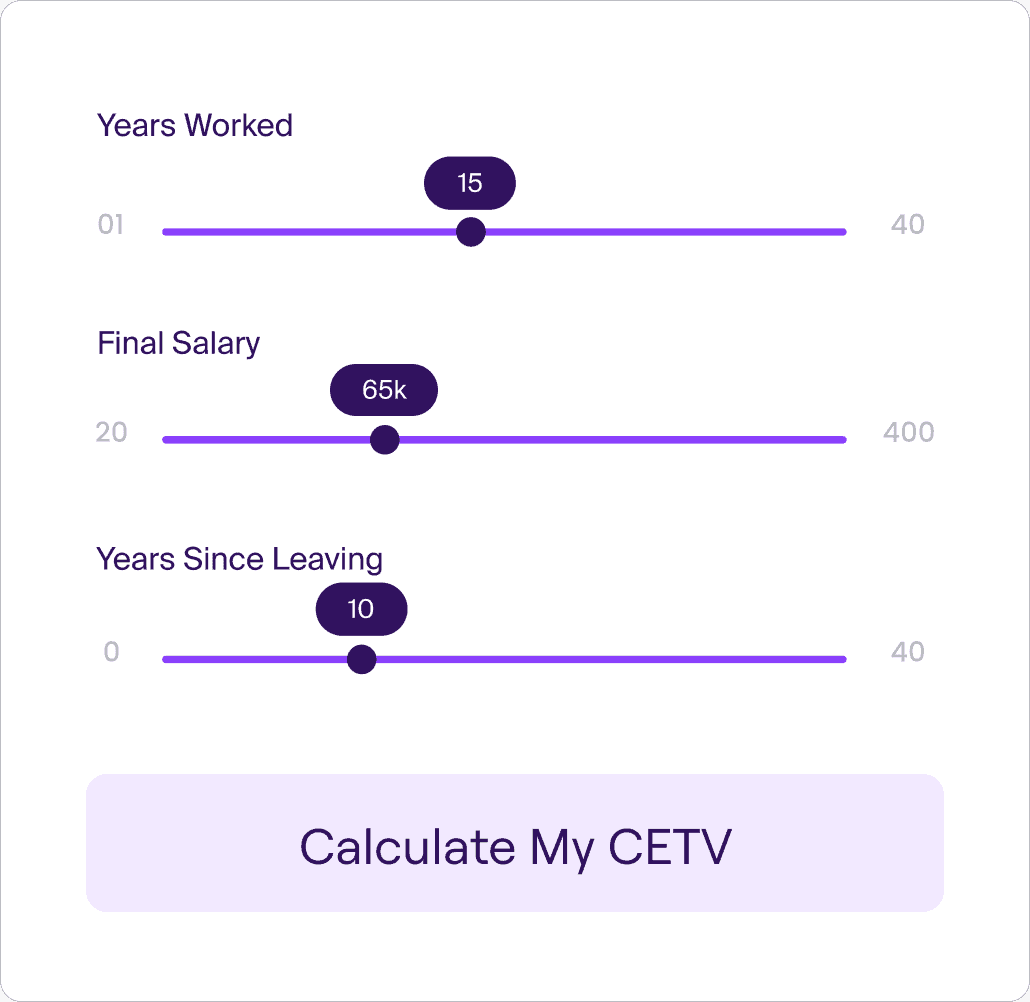
Pension Transfer Value Calculator
A cash equivalent transfer value (CETV) is the cash value that you would receive from your private sector defined benefit pension provider into your own personal pension. Find out your estimate in 30 seconds with our pension transfer value calculator.
Inflation and Pension Transfer Values
Inflation assumptions can affect pension transfer values because many defined benefit pensions increase before or after retirement in line with an inflation measure, subject to the scheme’s rules and any caps or floors. The effect on the CETV depends on those indexation provisions and on the other financial assumptions used in the calculation.
Indexation and Pension Benefits
To maintain the purchasing power of your pension benefits throughout retirement, they must be adjusted for inflation. This adjustment, known as indexation, ensures that your pension payments increase in line with the rising cost of living. Defined benefit pension schemes typically use either the Retail Price Index (RPI) or the Consumer Price Index (CPI) to calculate annual increases in pension benefits.
From 2030 at the earliest, the methods and data sources used for CPIH (the Consumer Prices Index including owner-occupiers’ housing costs) are due to be introduced into RPI. RPI will continue to be published, and pension schemes are not required to switch from RPI to CPI.
The change is expected to reduce RPI inflation by around 1% point a year compared with how RPI would otherwise have been calculated, although the actual difference will vary over time. Members whose pension increases are linked to RPI may therefore receive lower increases than they would have under the existing methodology. Whether you are affected will depend on your scheme’s rules, including which inflation measure applies to your benefits and any caps or floors on increases.
What Is a Good Cash Equivalent Transfer Value (CETV)?
A good cash equivalent transfer value (CETV) depends on various factors, including your circumstances, the pension scheme’s terms, and market conditions. Here’s what you need to know to determine if your CETV is considered “good.”
Personal Factors
A good CETV should reflect your circumstances, such as your age, years of service, and expected pension benefits. For example, a higher CETV might be more attractive for someone closer to retirement age or with a longer service history. Your financial goals and retirement objectives should also be considered when evaluating CETV values.
Comparison to Pension Benefits
When assessing a CETV, you should compare it to the pension benefits you’d receive if you remained in the defined benefit pension scheme. A higher CETV value might be considered good if it represents a significant portion of the value of your pension benefits. However, it might be less appealing if you were giving up benefits that are valuable to you and hard to replace.
Market Conditions and Gilt Yields
As previously mentioned, market conditions and gilt yields play a significant role in determining the value of your CETV. Therefore, a good CETV should consider the current market conditions and the prevailing gilt yields. Lower gilt yields generally result in higher CETVs, while higher gilt yields lead to lower CETVs.
A lower CETV does not necessarily mean that transferring is more or less suitable. The decision should be based on the value of the benefits being given up, your retirement needs, the receiving pension and the risks and costs of investing the transferred funds.
Funding Position of the Pension Scheme
The funding position of your DB pension scheme can affect its approach to CETVs. A well-funded scheme may provide greater confidence in its ability to meet its pension obligations, while an underfunded scheme may be subject to a recovery plan designed to address the shortfall.
An underfunded position does not, by itself, mean that transferring is more attractive or that a lower CETV represents good value. The scheme’s funding position, the financial strength of the sponsoring employer and the protections available to members should be considered alongside the benefits you would be giving up and the transfer value offered.
Reasons for Considering a Pension Transfer
There are several reasons for considering a pension transfer, such as if you’re a British expat, consolidating multiple pension plans, seeking better investment options, or accessing flexible drawdown options.
British Expats
British expats considering a pension transfer may have several options, depending on their circumstances. These can include transferring to a UK-based international SIPP or, where appropriate, a Qualifying Recognised Overseas Pension Scheme (QROPS).
An international SIPP remains a UK-registered pension but may offer features designed for people living overseas, such as access to international investments and different currency options. A QROPS is an overseas pension scheme that meets HMRC’s requirements for a recognised overseas pension scheme.
The right option will depend on factors including your country of residence, tax position, retirement plans, investment requirements, charges and the rules of the receiving scheme.
Transfers to a QROPS can be subject to the UK’s 25% overseas transfer charge and are also tested against the member’s available overseas transfer allowance. An international SIPP and a QROPS can have very different UK and local tax consequences, so they should not be treated as interchangeable options.
Cross-border expat pension advice can help you understand the UK and local tax and regulatory implications and whether a transfer is appropriate for your circumstances.
Where regulated pension transfer advice is required under UK law, the advice must be provided by a firm with the appropriate FCA permissions. Depending on where you live and the proposed receiving arrangement, advice from a suitably authorised adviser in your country of residence may also be needed.
Consolidating Multiple Pension Plans
Over the course of your working life, you might accumulate multiple pension plans with different providers. This can make managing retirement funds complex and challenging. By consolidating suitable pension plans through a pension transfer, you can simplify your retirement planning and reduce administrative burdens. Consolidation may also lower management fees, although this will depend on the charges of your existing pensions and the receiving scheme. It can also provide a clearer overview of your pension savings, making it easier to plan for retirement and, where applicable, track investment performance.
Seeking Better Investment Options
Pension transfers can open up new investment opportunities that may not be available in your current pension scheme. For example, you can transfer from a defined benefit pension scheme to a defined contribution scheme, which may offer a broader range of investment choices. This could allow you to tailor investments more closely to your personal risk tolerance, preferences, and financial goals.
Transferring a defined benefit pension to a defined contribution arrangement can provide greater investment choice and, depending on the receiving scheme, different charges. However, future investment performance is not guaranteed, and you would be giving up the safeguarded benefits provided by the DB scheme in exchange for benefits whose future value will depend on investment performance.
Accessing Flexible Drawdown Options
Another reason for considering a pension transfer is to access more flexible drawdown options during retirement. By transferring a pension to a scheme that allows flexible drawdown, you can have greater control over your retirement income and the tax you pay. This can include varying the amount and frequency of withdrawals and leaving remaining pension funds to beneficiaries. The tax treatment of those benefits depends on the applicable UK rules and, for expats, the rules in the country concerned. Getting specific expat tax advice is crucial to understand the best option for you.

Defined Benefit Pension Analysis Service For Expats
Understand how your final salary pension fits into your wider retirement plan. We’ll model both staying and transferring—so you can balance income certainty with flexibility and make the right choice for your life abroad.
What Is the Difference Between Pension Fund Value and Transfer Value
When evaluating pension options, you should understand the difference between the pension fund value and transfer value. These two values play distinct roles in pension planning, and grasping their differences can help you make informed decisions about your pension options.
Pension Transfer Value
The transfer value of a defined benefit pension represents the monetary value of your pension benefits if you decide to transfer your pension scheme or release cash. It provides an estimate of your pension benefits in a lump sum form.
Pension Fund Value
The pension fund value, on the other hand, is the current market value of the investments in your pension plan. It represents the total value of your pension savings and reflects the performance of your investments over time. For defined contribution pension schemes, the fund value determines the amount of money available for your retirement income. However, for defined benefit pension schemes, the fund value is not directly linked to the pension benefits you will receive.
Why Is My Pension Transfer Value Higher Than the Fund Value?
The transfer value for a defined benefit pension can be higher or lower than the fund value, depending on market conditions, life expectancy, and pension scheme funding position. Understanding the differences between pension value and pension fund can help you make more informed decisions about transferring your pension or remaining in your current pension scheme.
Can I ‘Cash In’ My Pension Transfer Value
You cannot normally take your pension transfer value directly as cash from a defined benefit pension scheme. If you decide to transfer, the CETV is paid to an eligible receiving pension arrangement, such as a personal pension.
You may then be able to access benefits from the receiving pension, subject to the applicable pension rules, tax treatment and minimum pension age. Depending on your financial situation and retirement goals, this may be an option to consider. However, there are several important conditions:
Eligibility and Conditions
The minimum pension age generally determines when you can start taking pension benefits; it does not normally determine whether you can transfer a CETV. The normal minimum pension age is currently 55 and is due to rise to 57 from 6 April 2028, although protected pension ages and certain exceptions can apply.
It is important to note that you cannot normally receive your pension transfer value directly as cash. Instead, if you transfer, the CETV is paid to an eligible receiving pension arrangement, such as a personal pension. From there, you may be able to access your pension benefits once you meet the relevant conditions.
Under UK pension tax rules, you can usually take up to 25% of your pension benefits as a tax-free lump sum, subject to your remaining Lump Sum Allowance. Since the Lifetime Allowance was abolished in April 2024, the standard Lump Sum Allowance has been £268,275. Previous tax-free lump sums can reduce the allowance you have remaining, while certain protections can provide a higher allowance. If you live overseas, the lump sum may also be subject to tax in your country of residence.
Tax Implications
Be aware of the tax implications when transferring your pension transfer value. Withdrawals above the tax-free cash lump sum (usually 25% of your pension value) are subject to income tax. Therefore, strategically planning your withdrawals to minimise your tax liability is essential. This money could then be used to invest in a buy-to-let property or you could choose to pay off the mortgage. Again, by working with a financial adviser, you can explore different options with economic models for each.
Get Your Complimentary Pension Transfer Assessment Report
Get a personalised, three-stage pension transfer assessment with Titan Wealth International. In just 15 minutes, discover:
- The pension transfer benefits you’re eligible for.
- The best options tailored to your needs.
- The specific pros and cons of a pension transfer for your unique situation.

The Importance of Financial Advice
Seeking professional financial advice is crucial when considering your pension CETV. A dedicated pension transfer financial adviser can help you with the following:
- Assess your pension transfer value and determine whether it’s in your best interest to transfer or release cash from your pension.
- Compare different pension schemes and investment options.
- Understand the tax implications and potential risks associated with pension transfers.
The £30,000 Rule: When Regulated DB Transfer Advice Is Mandatory
If the safeguarded benefits you want to transfer or convert are worth more than £30,000, you are generally required by law to obtain appropriate independent advice from an FCA-authorised firm with the relevant pension transfer permissions before the transfer can proceed. Pension transfer specialists are financial advisers with the appropriate qualifications and permissions to provide advice on transfers from defined benefit pension schemes. To find an adviser or check whether a firm is authorised, you can use the FCA’s Financial Services Register.
The specialist will assess your specific circumstances and objectives and recommend whether or not to proceed with the transfer. To do so, they might ask about:
- Your reasons for giving up a guaranteed income.
- Your target retirement income.
- Your plans for the transferred funds.
- Your ability to adjust your lifestyle or spending in retirement if the pension fund performs worse than expected.
For British expats, coordinating a pension transfer can be more complex because both UK and overseas regulatory requirements may need to be considered. A UK FCA-authorised pension transfer specialist can provide advice on the UK pension transfer where the firm has the appropriate permissions, but additional advice may be needed in your country of residence. Depending on where you live and the proposed receiving arrangement, this could involve a locally regulated cross-border financial adviser who can advise on local tax, investment and regulatory considerations.
Frequently Asked Questions
A Cash Equivalent Transfer Value (CETV) is normally guaranteed for three months. The exact guarantee date and deadline will be shown on your transfer statement. After the guarantee period expires, the scheme may recalculate the CETV using its current financial and actuarial assumptions, so the new value may be higher or lower.
Do I legally have to take regulated financial advice before transferring my defined benefit pension?
If the safeguarded benefits you want to transfer or convert are worth more than £30,000, UK law generally requires you to obtain appropriate independent advice from an FCA-authorised firm with permission to advise on pension transfers before the transfer can proceed. This requirement applies whether you live in the UK or overseas. If the value is £30,000 or less, there is no equivalent statutory requirement to take transfer advice, although you can still choose to seek regulated advice.
Your CETV represents the calculated present value of the defined benefits you would give up if you transferred, rather than the value of an individual investment pot. A defined benefit pension promises benefits based on the scheme’s rules, while the CETV is calculated using financial and actuarial assumptions. This means it should not be compared directly with the fund value of a defined contribution pension.
Under UK pension tax rules, you can usually take up to 25% of your pension benefits as a tax-free lump sum, subject to your remaining Lump Sum Allowance. The standard Lump Sum Allowance is £268,275 across all your pensions, although previous tax-free lump sums can reduce the amount you have remaining and certain protections can provide a higher allowance. If you live overseas, the lump sum may also be taxable in your country of residence under local law and the applicable double-tax treaty.
Rising gilt yields can contribute to higher discount rates being used to value future pension payments. Higher discount rates reduce the present value placed on those future benefits, which can result in a lower CETV. However, gilt yields are not the only factor used to calculate a transfer value, and the assumptions and methodology will depend on the scheme.
Living overseas does not, by itself, prevent you from transferring a UK pension. Depending on your circumstances and the scheme’s rules, possible receiving arrangements may include a UK-based international SIPP or, where appropriate, a Qualifying Recognised Overseas Pension Scheme (QROPS). The tax treatment, regulatory requirements, charges and available options will depend on your country of residence and the receiving arrangement. Where safeguarded benefits worth more than £30,000 are being transferred, the UK regulated-advice requirement still applies even if you live overseas.
A transfer to a Qualifying Recognised Overseas Pension Scheme (QROPS) can be subject to the UK’s 25% overseas transfer charge, depending on the circumstances of the transfer and whether an exemption applies. Transfers are also tested against your available overseas transfer allowance, which is normally £1,073,100 for the 2026/27 tax year. Tax may also arise in your country of residence, so both UK and local tax rules should be considered before transferring.
Key Takeaway
Understanding your pension transfer value is an important part of assessing your retirement options. Factors such as age, life expectancy, interest rates, inflation and gilt yields can all influence a CETV, but the value alone does not determine whether transferring is right for you.
A pension transfer may offer greater flexibility for some British expats, people looking to consolidate suitable pensions, or those seeking flexible drawdown and wider investment options. However, transferring a defined benefit pension means giving up safeguarded benefits, and the tax implications, costs and risks should be considered carefully. For expats, your country of residence and local tax rules may also affect the options available and how pension benefits are taxed.
Professional pension advice can help you compare the benefits of remaining in your existing scheme with the options available if you transfer. Get your complimentary pension transfer assessment report for personalised insights based on your circumstances.
This article is provided for general information only and reflects our understanding at the date of publication. It does not constitute personalised financial, investment, tax or legal advice and does not take account of your individual circumstances. Tax, legal and regulatory treatment varies between jurisdictions, and you should seek professional advice appropriate to the countries in which you may have liabilities. Titan Wealth International accepts no liability for any direct or indirect loss arising from reliance on this information, or for any errors or omissions.